

I would consider bats a misunderstood creature. Similar to sharks, bats are often the villain in many stories. They are frequently depicted as evil, blood-sucking creatures that are out to get you. However, that is not true. There is much more to bats than meets the eye. Hopefully, this list of 10 incredible bat facts will help you learn to love these remarkable creatures.
1. There Are Over 1,400 Species Of Bat

Pexels image by HitchHike
For starters, there is not just one type of bat. There are over 1,400 species of bat. The U.S. Department of Interior shares that "Bats can be found on nearly every part of the planet, except in extreme deserts and polar regions." In addition to their vast habitat, bats also vary significantly in their physical appearance. For example, the smallest bat, the Kitti's hog-nosed bat, weighs less than a penny. Whereas the largest bat, the flying fox, has a wingspan of up to 6 feet!
2. Bats Are Extremely Important Pollinators

Pexels image by Erick Arce
When thinking of pollinators, most people think of bees. While bees and other insects are essential pollinators, they are not the only ones. Bats help pollinate some of your favorite foods. Over 300 species of fruit depend on bats. Without bats, you could say goodbye to bananas, avocados, mangoes, and *gasp* even chocolate!
3. They Have A Hearty Appetite

Pexels image by Itai Perelman Nasich
While some of these bats may be small in size, they are expansive in appetite. Did you know that bats can eat their body weight in insects? Oh, and they do that every night! Can you imagine eating your body weight every night!? Not only does that habit help keep the bat sustained, but it also greatly assists farmers. Having an insect-heavy diet allows bats to limit the number of insects that prey on the farmer's crops.
4. Bats Are The Only Flying Mammal

Pexels image by John Torasio
Come on, you have to admit this is one of those really cool bat facts. I know what you are thinking, but what about the flying squirrel? Despite its misleading name, the flying squirrel does not actually fly. Instead, it glides for short distances. The bat, however, is capable of full flight, making it the only mammal capable of doing so.
5. Bats Are Not Dirty
Pixabay image by tomatomicek
I think because they are often cast as the villain, people assume that these creatures are dirty. However, that is not the case. Similar to cats, bats groom themselves, and they do so often. In addition to grooming themselves, they also take time to groom one another. Grooming isn't just about looking good for bats; it also helps control parasites.
6. They Can Find Their Food Easily In The Dark

Pexels image by Ian Gabaraev
Ironically, the saying 'blind as a bat' is more misleading than ever. Not only are bats not blind, but they actually have very sensitive vision. This allows them to see in conditions that you and I may consider pitch black. However, they do not rely only on their vision to catch their prey. Instead, they use echolocation. Similar to dolphins, bats can locate their food by emitting inaudible high-pitched sounds. It is truly quite remarkable.
7. There Is A Reason They Hang Upside Down

Pixabay image by Salmar
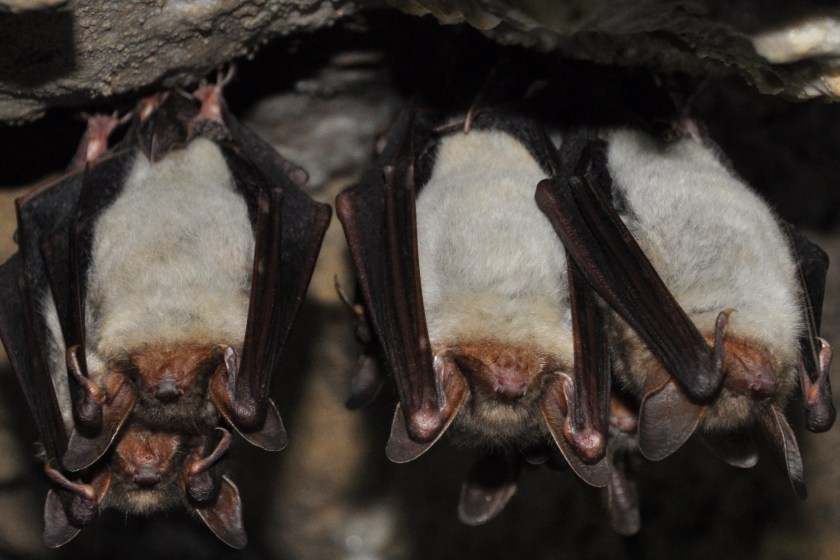
Next on our list of bat facts, we have this unique tidbit of information. Bats have two main reasons for their iconic hanging upside-down position. First, it helps reduce the risk of being attacked by predators. After all, who is going to try to get you when you are high up on the ceiling of a cave? Second, it is more advantageous for them to fly. Unlike many bird species, bats do not have hollow bones. The Bat Conservation International shares that this means, "they can't withstand the compression standing up." While they can take off from the ground, it is much more difficult. Hanging upside down allows them to become airborne effortlessly.
8. Only 3 Species Are Hematophagous

Getty Images
Despite horror films portraying bats as bloodthirsty creatures, only three of the many species are known to enjoy blood. The three species are all known as vampire bats. Those three species are the common vampire bat (Desmodus rotundus), the hair-legged vampire bat (Diphylla ecaudata), and the white-winged vampire bat (Diaemus young). Additionally, they do not live up to the fearful hype about them. They are not lustful, blood-sucking creatures. Instead, they make a small incision in their prey with their teeth and take a quick drink. They have a special anticoagulant in their saliva that allows the blood to flow continuously. Also, have no fear... humans are not their primary prey source. Instead, they feed on wild or domesticated animals. Your livestock is their main food source, so be wary of that.
9. Bat Feces Are Great Fertilizer

Pixaby image by BenMayr
Now here is one of those bat facts I bet you were not expecting to read today. However, the Nature Conservancy shares this interesting tidbit of information. Bat droppings, also called guano, "was Texas' largest mineral export before oil!" That is right, folks, bat poop is one of the richest fertilizers, and Texas had a ton of it. That is because Austin, Texas, is home to the largest urban population of Mexican free-tailed bats in North America.
10. Bats Have An Incredibly Fast Heartbeat

Pixabay image by Saken53
I guess if you are busy eating 1,200 mosquitoes an hour, your heart must be working pretty hard. During those intense feeding frenzies, their hearts have to work extra hard to keep them going. National Geographic Kids shares the astonishing fact that "when in flight, bats' hearts beat 1,000 times a minute!"

